We can fully attend to only one thing at a time. Multitasking is an illusion. Task switching is expensive. To write well, you need to protect your focus. You either write, structure, or format. Avoid doing everything at once. You’ll write better, and enjoy it more.
How do we deal best with a complicated matter? We separate it into different tasks and do them one after the other. We focus on one thing at a time. Writing is no exception. It demands concentration. Yet writing on a computer usually invites the opposite: finding words, structuring the narrative, and formatting all at once.
We write best when we do each aspect with as much focus as possible. Focus creates joy. And when we enjoy what we do, we do it better.
- We express ourselves best when we focus on what we want to say.
- We structure best when we focus on the order of ideas.
- We format best when we focus on presentation.
When we give each aspect of writing our full attention, we do it as well as we can. The difficulty is that message, structure, and expression are intrinsically connected and eventually come together in the final presentation. To avoid switching too often, we need boundaries that help us focus on one task at a time.
Writing needs initiative to get started, persistence to keep going, and once we find our voice, we need to carefully hold onto it. Having to master so many different skills makes writing especially fragile. We get distracted not just by outside signals, but by the different aspects of writing that constantly call for our attention.
To stay focused, we need to understand the ideal conditions for each aspect of writing and identify what exactly distracts us. Once we understand the good, the bad, and the distractions, we can figure out how to replace bad habits with new habits to write better.
1. Our Brains While We Write
1.1. When you type just type, when you structure, just structure…
The solution to staying focused while writing sounds trivial: When you type, just type. When you structure, just structure. When you format, just format. Why is that so hard?
We’ve been trained to write in apps built for everything, but mainly for the final product: for layout. Word processors, apps to design slide decks, CMS editors—they present, invite, and reward formatting. We highlight, click, drag, align, adjust. And it does feel productive. And it seems efficient to work in the final stage from the start. In fact, it’s the very opposite of efficient. Clicking and tapping, dragging and dropping distracts us from expressing ourselves.
The remedy: If you have a clear idea of where you are going, just type, and forget everything else. Focus on typing paragraphs and grouping them under plain headings. Structure and format later.
1.2 Typing, Structuring and Formatting are Different
We use different parts of the brain when we write, when we structure, and when we format. Writing primarily involves language processing and motor coordination. Structuring requires a different type of abstract thought than regular verbal expression. Formatting involves spatial processing and activates different brain regions. Activating different processes in succession uses time and energy. It drains us in an insidious way: as we switch tasks, we don’t notice the energy we waste. We don’t even notice how much time it takes to switch. The key to writing well is doing the very opposite of multitasking: reducing context switching and staying in one mode of thought for longer. 1
Simply put: Every time you stop to rethink the order of your narrative or you change gear and start styling how words look, you lose your train of thought.
“…good writers performing more efficiently than poor writers with respect to brain regions activated during a writing task across handwriting, spelling, and idea generation.”2
To change a sentence into a different color, font or font variant, your mind needs to switch into a different mode. It switches from verbal to visual. It switches from what do I feel and how do I express it? to how does this look and how do I make it look better? 3
1.3 Switching Modes Drains Our Focus
If you enjoy both writing and design, you may have sensed that doing both in quick succession feels strangely frustrating. You like both, but not back to back. It’s not laziness. We can focus on either for hours. The frustration comes from switching between fundamentally different types of focus. We experience pleasure in work only when we can do it with full concentration.
Writing and structuring can be highly pleasant tasks. But switching from writing to structuring and formatting is like jumping between your favorite song and your favorite movie every few seconds. You ruin both. The more we enjoy doing one thing, the harder it is to abruptly shift to something else, even if we normally enjoy it, too.
2. The Hidden Cost of Multitasking
2.1 Similar Tasks Can Cause Greater Mental Friction
There’s overlap between writing, structuring and formatting: Verbal and visual language go hand in hand. We need to format when we write. We need paragraphs, we need to group those paragraphs with headings. Sometimes the emphasis on a word is an essential part of the meaning we want to express. And vice versa: formatting and structuring are connected, and both require writing. There is an unavoidable overlap. But we do each better when we do them separately. Focus improves everything. Typographic design can be deeply satisfying, but not when it’s tangled with sentence construction.
“Switching between tasks that require overlapping cognitive processes typically results in greater switch costs than switching between tasks engaging distinct processes.”4
Switching tasks takes more time and energy than we realize. It happens in three steps: disengage, shift, reengage. 5 That mental shuffling costs attention and drains energy. Ironically, switching between similar tasks—like writing and formatting—can be even worse because they demand overlapping brain resources. You’re asking overlapping mental resources to do conflicting jobs.
2.2 How Graphical Interfaces Hijack Our Attention
Jef Raskin, inventor of the Macintosh, called it a shift in “locus of attention.”6 A keystroke takes about 0.2 seconds. A mouse click takes over a second.7 The real loss? It’s not in time. It’s in attention. When your hands move, your thinking moves. And when your thinking moves, your writing stalls. It can take up to 10 seconds for us to fully switch focus.8
The real loss isn’t just time—it’s momentum. When your hands move, your thinking moves. And when your thinking moves, your writing stalls.
2.3 Why Formatting Breaks the Flow of Thought
Writing and formatting are two types of actions. Two forms of language. Two modes of thought. And yet, attention is singular. We can only focus on one thing at a time.
“…an essential fact about your locus of attention is that there is but one of them.” –Jef Raskin9
Switching between writing, structuring, and formatting is like doing a triathlon where you switch from swimming to biking to running every 30 seconds instead of finishing each leg. You never hit stride.
3. How to Stay Focused While Writing
3.1 Separate Form and Content
To write in a focused way, you have to just write. That means consciously drawing boundaries between drafting, structuring, and formatting.
We polish too soon. We format before ideas are clear. We structure and restructure too early because it’s easy to do. Modern writing tools tempt us with formatting bars and instant layout feedback. But this convenience comes at the cost of clarity.
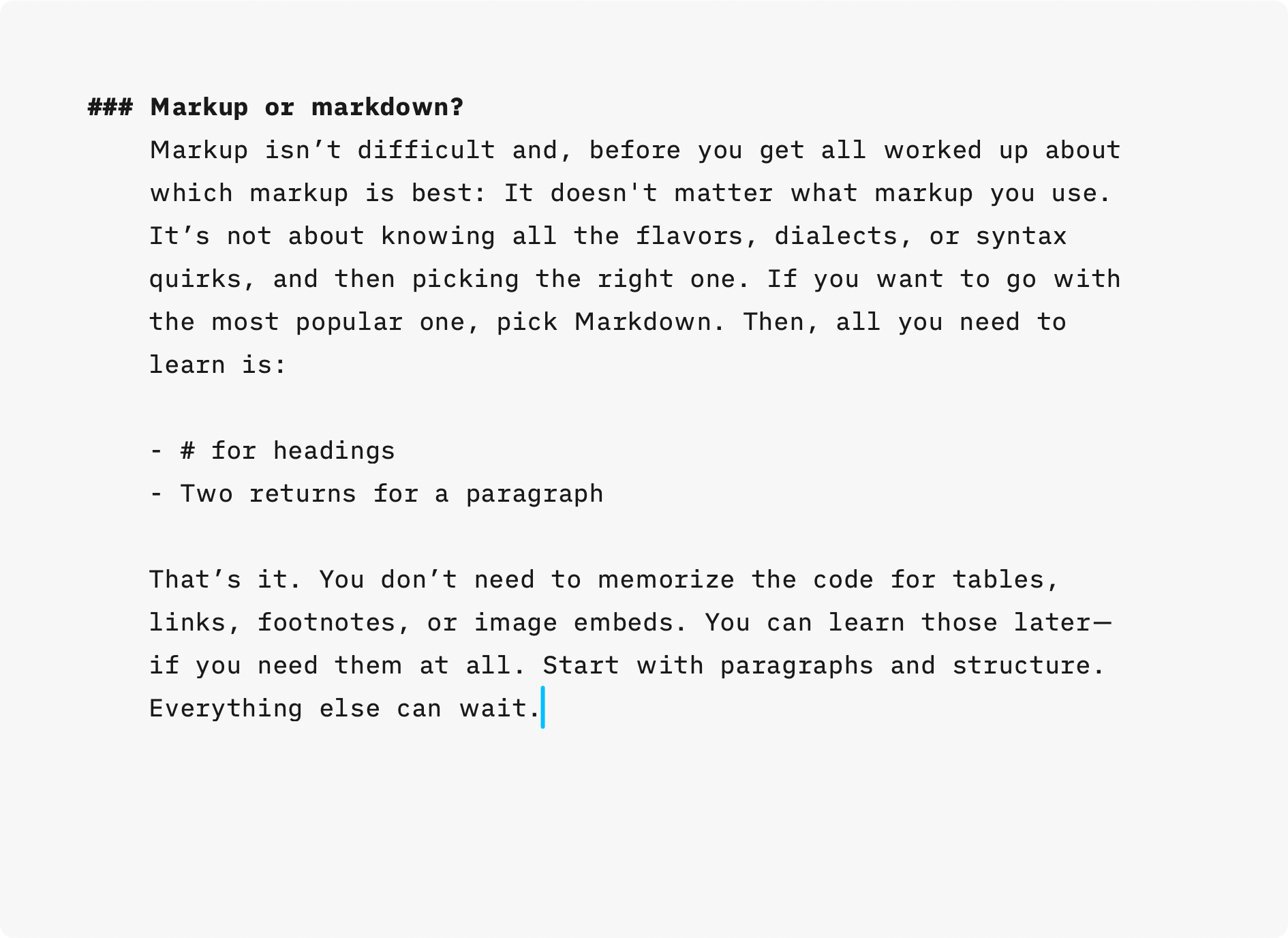
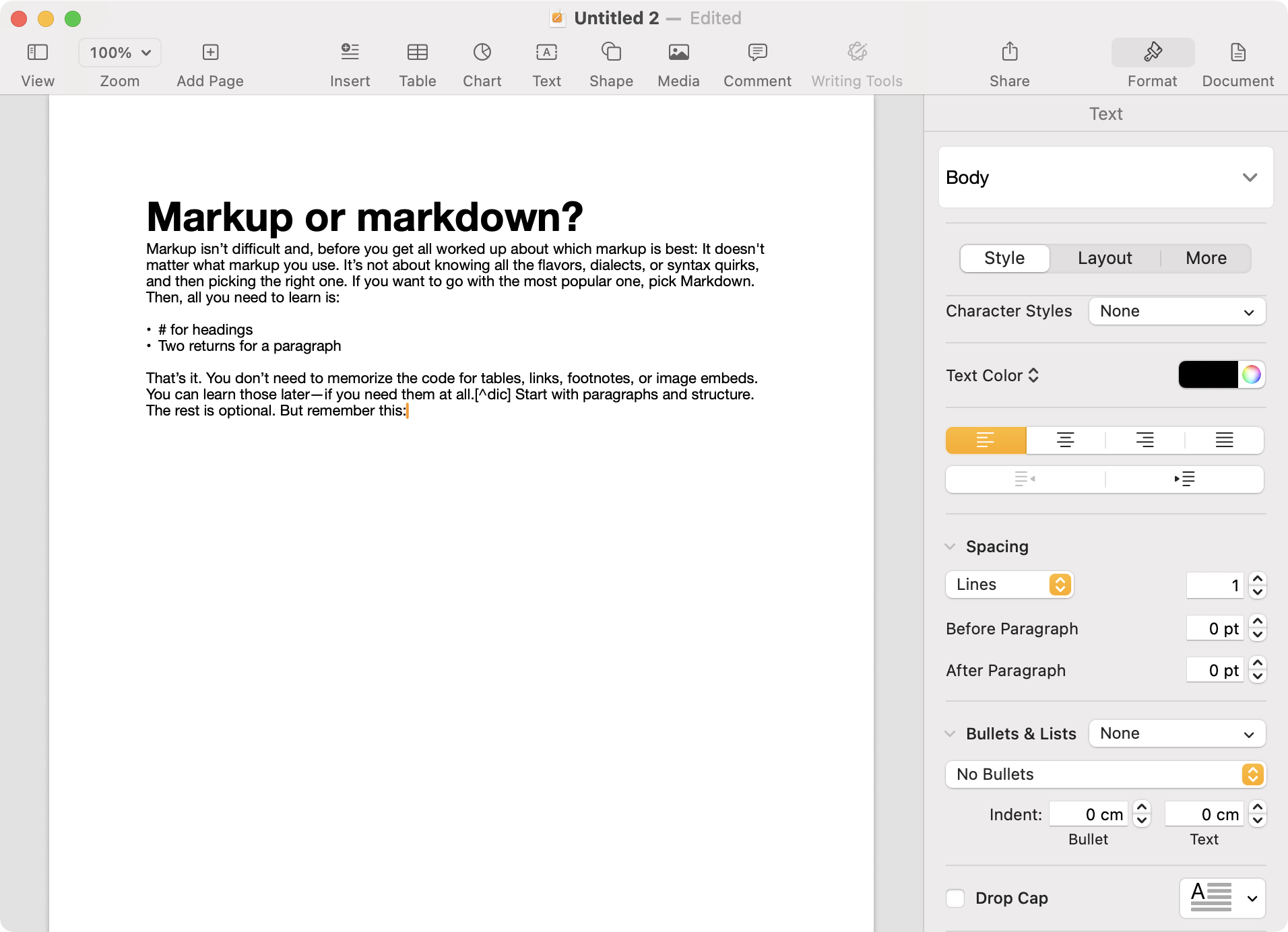
That doesn’t mean never format or structure while writing—you need some basic organization. Paragraphs help. Headings help. A simple outline helps. But multitasking between modes of thought kills focus.
Writing takes time. Structuring takes time. Formatting takes time. Do each one at a time, as separately as you can, and you’ll do them all better (and faster).
Try it. Write one paragraph. Then another. Add a heading. Keep going. It’ll feel quieter. Cleaner. Clearer. You’re not switching modes. You’re just writing.
3.2 Replace Old, Bad Habits with New Good Ones
Markup can help you focus—if you keep it light. Don’t overload your first draft with links, images, or formatting. For early writing, paragraphs and headings are enough.
Changing habits is hard. Especially old ones. But the reward is enormous. As Mihaly Csikszentmihalyi put it, the most enjoyable activities are often the ones that require effort to start. But once you hit flow, you don’t want to stop.
“Most enjoyable activities are not natural; they demand an effort that initially one is reluctant to make. But once the interaction starts to provide feedback to the person’s skills, it usually begins to be intrinsically rewarding.”— Mihaly Csikszentmihalyi, Flow: The Psychology of Optimal Experience10
Learning a tool like Markdown may seem tedious at first, but it’s easier than you think. And once you do, it frees you. You stop clicking and start thinking. That’s when writing becomes joyful again.
Summary
We only have one attention. Multitasking is an illusion. Task switching is expensive. To write well, you need to protect your focus.
Traditional writing tools distract you. They invite multitasking and reward surface polish over substance. To write better, separate writing from formatting. Draft first. Style later. Focus is everything.
Writing is hard—but when you get into flow, it becomes something else: absorbing, clear, energizing. Once you’ve felt that, you won’t want to go back.
-
Typing activates the Left Inferior Frontal Gyrus or Broca’s Area for language production and processing and the Left Superior Parietal Lobule, associated with motor planning and coordination necessary for finger movements during typing. There are substantial differences between typing and writing by hand. See https://www.mdpi.com/2075-1729/15/3/345 and fMRI Studies of Writing Processes in the Brain ↩
-
See Lara-Jeane C. Costa, Sarah V. Spencer, Stephen R. Hooper, Emergent Neuroimaging Findings for Written Expression in Children: A Scoping Review ↩
-
Design activities involve the Left Prefrontal Cortex, which is significantly active during tasks requiring graphic design thinking, especially in the refinement stages of the design process. The Right Lateral Prefrontal Cortex is associated with creative tasks and the integration of complex visual information. The Parietal and Occipital Lobes are involved in visual processing and spatial orientation, essential for imagining and creating designs. See Mapping the artistic brain: Common and distinct neural activations associated with musical, drawing, and literary creativity, or How specialized are writing-specific brain regions? An fMRI study of writing, drawing, and oral spelling ↩
-
Monsell, S. (2003). Task switching. Trends in Cognitive Sciences, 7(3), 134–140. See also: Dosenbach, N. U. F., et al. (2008). A core system for the implementation of task sets. Neuron, 50(5), 799–812: “Task-set inertia and interference are most pronounced when successive tasks share stimulus or response features.” ↩
-
A big thank you to Prof. Jäncke for explaining the neuroscience behind this. In an email exchange, he explained: “These three processes—disengagement, shift, and reengagement—consume cognitive energy and time and place a significant load on the brain. They lead to reduced performance, slower reaction times, increased error rates, and faster mental fatigue. The reason lies in the need to constantly activate new cognitive contexts while suppressing previous ones—a process that heavily taxes the brain’s executive system.
Neurologically, these switching costs are well-documented. Imaging techniques like functional magnetic resonance imaging (fMRI) show increased activation in the prefrontal cortex, the anterior cingulate cortex, and the parietal lobe. EEG studies also confirm the added strain, for example, through altered potentials (e.g., P300) and increased frontal theta activity. These findings make one thing clear: the brain is not built for constant multitasking. Every task switch costs time, energy, and attention.” For more on the topic, see the chapter “Aufmerksamkeit” in his book Einführung in die Kognitiven Neurowissenschaften. Having such a knowledgeable user base is an incredible privilege. We build tools for them, and the work they create flows back to us and reshapes the tools. ↩ -
Jef Raskin was very precise with words. He had his reasons not to call it “focus” as we might: “I use the term locus because it means place, or site. The term focus, which is sometimes used in a similar connection, can be read as a verb; thus, it conveys a misimpression of how attention works. When you are awake and conscious, your locus of attention is a feature or an object in the physical world or an idea about which you are intently and actively thinking. You can see the distinction when you contemplate this phrase: “We can deliberately focus our attention on a particular locus.” Whereas to focus implies volition, we cannot completely control what our locus of attention will be. If you hear a firecracker unexpectedly exploding behind you, your attention will be drawn to the source of the sound. Focus is also used to denote, among the objects on a computer display, the one that is currently selected. Your attention may or may not be on this kind of focus when you are using an interface. Of all the world that you perceive through either your senses or your imagination, you are concentrating on at most one entity. Whatever that one object, feature, memory, thought, or concept might be, it is your locus of attention. Attention, as used here, includes not only the case of actively paying attention but also the passive case of going with the flow, or just experiencing what is taking place.” –Jef Raskin, The Humane Interface, Chapter 2.3, Locus of Attention ↩
-
“The amount of information conveyed by nonkeyboard devices can also be calculated. If your display is divided into two regions—one labeled Yes and the other labeled No—a single click in one or the other region would supply 1 bit of information. If there are n equally likely targets, with one click, you supply log2n bits of information. If the targets are of unequal size, the amount of information given by each does not change, but it does take longer to move the GID to smaller targets—by an amount that we shall show how to calculate presently. If the targets have unequal probability, the formula is the same as that already given for keyboard inputs with unequal probabilities. There is a difference in that a user can operate a keyboard key in 0.2 sec, whereas it will take 1.3 sec to operate an on-screen button, on average, ignoring homing time.” –Jef Raskin, The Humane Interface, Chapter 4.3, Measurement of Interface Efficiency ↩
-
“That people have a single locus of attention is not always a drawback. Magicians exploit this characteristic shamelessly. A good magician can fix the attention of an entire audience on one hand so that not a single spectator will see what the other hand is doing, although that hand is in no way concealed. If we know where the user’s attention is fixed, we can make changes in the system elsewhere, knowing that the changes will not distract the user. […] It takes about 10 seconds for a person to switch contexts or to prepare mentally for an upcoming task (Card, Moran, and Newell 1983, p. 390) […]. Many people do not believe that it takes a person approximately 10 seconds to switch contexts; the time is measured between the final command executed in the previous context and the first command issued in the new context. The hiatus is not noticed because the minds of the users are occupied; they are not aware of the passage of time. However, this phenomenon should be used carefully when designing an interface. If the workflow is such that a user makes a particular context switch repeatedly, so that it becomes habitual, the user will make the switch in far less time.” –Jef Raskin, The Humane Interface, Chapter 2.3.5, Exploitation of the Single Locus of Attention ↩
-
The full quote says: “For our purposes, an essential fact about your locus of attention is that there is but one of them. This observation underlies the solution of numerous interface problems. Many people do not believe that they or others have only one locus of attention, but experiments, described in the cited literature, strongly support the hypothesis that we are unable to attend to multiple simultaneous stimuli.” —Jef Raskin, The Humane Interface, Chapter 2.3.3, Singularity of the Locus of Attention ↩
-
For those raised on 30 years of formatting instead of writing, real writing might feel as daunting as learning to play the guitar. But just like learning to play the guitar, it’s both empowering and fulfilling. Now, remember: learning point and click apps was not easy either. We just forgot all the trouble we went through to learn it. It may not be fair, but for a young mind, learning Markdown is not such a hassle. Letting a template do the formatting may seem easier than dragging the ball and chain of PowerPoint, Keynote, and Google Slides. ↩